Icing and Offside in Hockey Explained: NHL Rules for New Fans
Icing in hockey is when a team shoots the puck from its own half of the ice all the way past the opponent's goal line without anyone touching it. The linesperson stops play, the faceoff comes back to the end zone of the team that iced it, and that team is not allowed to change players. Offside is different: it is called when an attacking player crosses the offensive blue line before the puck does, and the faceoff moves outside the zone.
Both are whistles, not penalties. Everything below comes from the NHL Official Rules 2026-2027, Rule 81 (icing) and Rule 83 (offside).
The lines that decide icing and offside
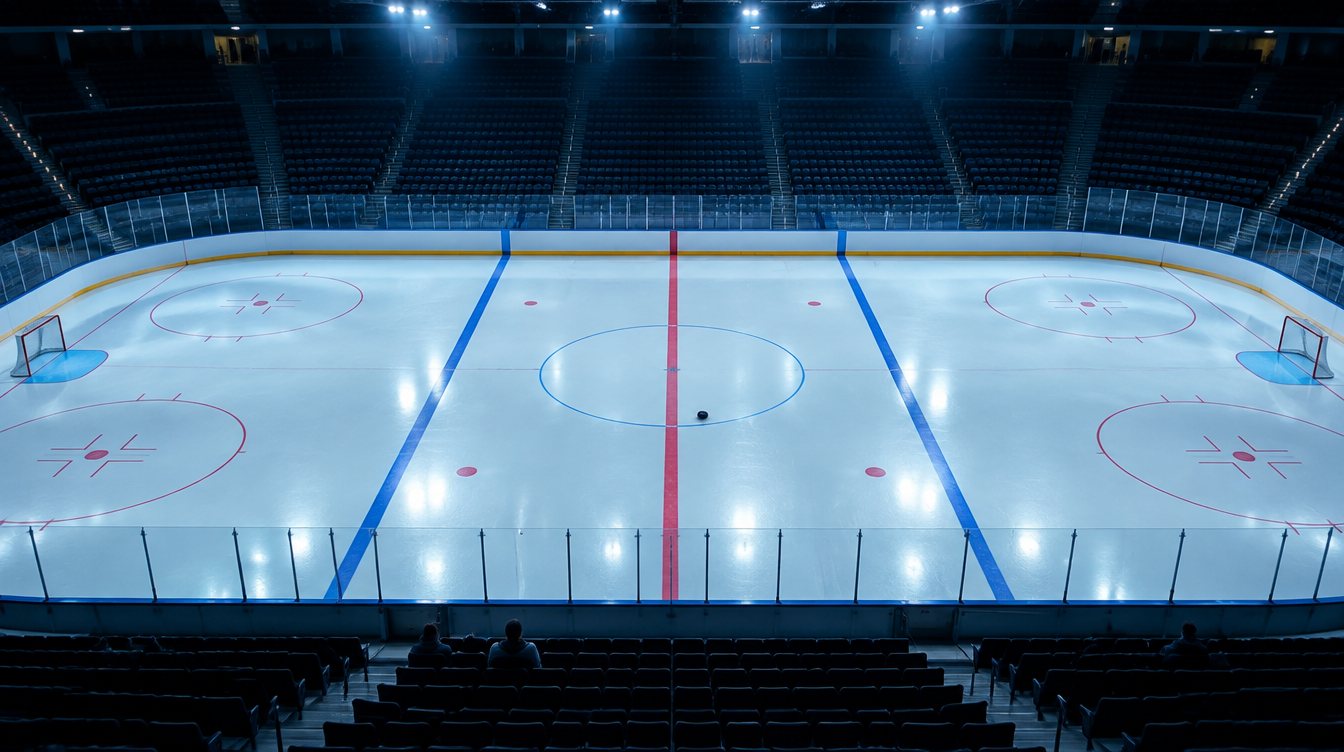
The center red line splits the rink into halves and decides icing. The two blue lines mark the edge of each attacking zone and decide offside.
| Icing | Offside | |
|---|---|---|
| Line that matters | Center red line, then the opponent's goal line | The attacking blue line |
| What triggers it | Puck shot from your own half past the opponent's goal line, untouched | An attacking player's skates entering the zone before the puck |
| Called against the shorthanded team? | No | Yes |
| Faceoff location | End zone dot of the team that iced it | Usually just outside the blue line |
| Line change allowed? | Not for the team that iced it | Yes |
| Penalty? | No | No |
What is icing in hockey?
Under Rule 81.1, icing happens when a team at equal or greater strength shoots, bats or deflects the puck from its own half of the ice beyond the opposing team's goal line. To avoid icing, the team must "gain the line": the puck has to touch the center red line while still on the player's stick, not his skate.
The linesperson then judges whether the puck will cross the goal line and which player, attacker or defender, would touch it first. That call is made by the moment the first player reaches the end zone faceoff dots. Defender first means icing; attacker first means play on; too close to call means icing.
What is hybrid icing?
Hybrid icing is the name for that race to the faceoff dots. The NHL and the NHL Players' Association announced it for the 2013-14 season after a player survey in which a majority of teams supported the change (NHLPA). The NHLPA's Mathieu Schneider described it as "a middle ground between the old rule and no-touch icing," meant to "help minimize the incidence of Player injuries on icing plays."
When is icing not called?
Icing is not called when:
- The team is shorthanded. A team killing a penalty can ice the puck freely (Rule 81.6).
- The goalie plays it. If the goalie plays the puck, feigns playing it or skates toward it, icing is waved off (Rule 81.3).
- A defender could have played it. If any opposing skater was able to play the puck before it crossed the goal line and chose not to, play continues (Rule 81.5).
- An opponent touches it. If the puck touches any part of an opposing player or the goalie, before or after crossing the goal line, it is not icing (Rule 81.5).
- It comes straight off a faceoff. A puck that goes the length of the ice directly off a faceoff is not icing (Rule 81.5).
What happens after icing?
The faceoff moves to an end zone dot in the offending team's defensive zone, and the other team chooses which dot (Rule 81.2). The team that iced it also cannot change players before that faceoff (Rule 81.4), except to replace an injured player, return a goalie pulled for an extra attacker, or respond to a penalty that changes the strength on the ice.
What is offside in hockey?
Rule 83.1 is short: "Players of the attacking team must not precede the puck into the attacking zone." The skates decide it, not the stick. A player is offside when both skates are completely over the leading edge of the blue line before the puck completely crosses that edge. He is onside if either skate is touching the blue line or still on his own side of it.
Since 2020-21, a skate in the air counts as onside as long as it has not broken the "plane" of the blue line, which the rulebook defines as extending upward from the line's leading edge (ESPN).
A puck carrier can cross the line ahead of the puck and stay onside if he controlled it with his stick before his trailing skate crossed and keeps control as it enters.
What is a delayed offside?
A delayed offside is when an attacker is already in the zone as the puck enters, but the defenders can bring it out without pressure, so the linesperson raises an arm instead of whistling (Rule 83.3). It is wiped out if all attackers clear the zone at the same instant, touching the blue line ("tagging up"), or if the defenders move the puck into the neutral zone.
The whistle blows if an attacker touches the puck, chases it or pressures the carrier first. A puck shot in to create a delayed offside that ends up in the net does not count, even if the attackers tagged up in time (Rule 83.4).
Where is the faceoff after offside?
Rule 83.6 sets the spot:
| How the offside happened | Faceoff location |
|---|---|
| Puck carried over the blue line | Neutral zone dot just outside the attacking zone |
| Puck shot or passed into the zone | Nearest dot in the zone where the pass or shot started, giving the offending team the least advantage |
| Intentional offside, to force a stoppage | End zone dot in the offending team's defending zone (Rule 83.7) |
Can a coach challenge offside in the NHL?
Yes, but only on a goal. Under Rule 38.2(a), a coach can challenge a goal if the attacking team was offside on the way in. The call stands unless video shows clearly it was wrong; if the challenge succeeds, the goal comes off and the clock resets to the moment of the offside (Rule 38.7).
A failed challenge costs a two-minute minor for delay of game, and any further failed challenge in the same game is a four-minute double minor (Rule 38.8). In the final minute of regulation and in overtime, the NHL Situation Room reviews those plays instead of coaches (Rules 38.3 and 38.6).
Did icing or offside change for 2026-27?
No. The rules above come from the 2026-27 rulebook, and the only rule change for the season, according to Scouting The Refs, requires players with no previous NHL games to wear cut-resistant neck protection.
Shop NHL jerseys
Watching the new season with a better grip on the whistles? Our NHL page has jerseys across the league, including the Connor McDavid jersey, the Alexander Ovechkin jersey and the Macklin Celebrini jersey.
Frequently asked questions
What is the difference between icing and offside in hockey?
Icing is about shooting the puck too far: from your own half past the opponent's goal line, untouched. Offside is about skating too early: an attacker's skates crossing the offensive blue line before the puck. Icing brings the faceoff back to the offending team's zone, while offside usually moves it just outside the attacking zone.
Is icing a penalty in hockey?
No. Icing stops play but nobody goes to the penalty box. The cost is territorial and physical: the faceoff moves to the offending team's defensive zone, the other team picks the dot, and the team that iced the puck cannot change its players before that faceoff, unless an injury, a goalie change or a penalty applies.
Can you ice the puck on a penalty kill?
Yes. Under NHL Rule 81.6, icing is not called against a team that is shorthanded because of a penalty. That is why penalty killers routinely fire the puck the length of the ice. If the penalty is about to expire, icing is judged at the instant the penalty ends, based on when the puck left the shooter's stick.
What is hybrid icing in the NHL?
Hybrid icing means the linesperson decides icing by a race to the end zone faceoff dots, so no player has to touch the puck to complete it. If the defender would reach the puck first, icing is called; if the attacker would, play continues. The NHL and NHLPA introduced it in 2013-14 to reduce injuries on icing plays.
What does tag up mean in hockey?
Tagging up is how attackers erase a delayed offside. When the linesperson raises an arm for a delayed offside, every attacking player must get back to the blue line at the same time, touching it with a skate. Once they have, the arm drops and they can re-enter the zone legally and chase the puck again.